
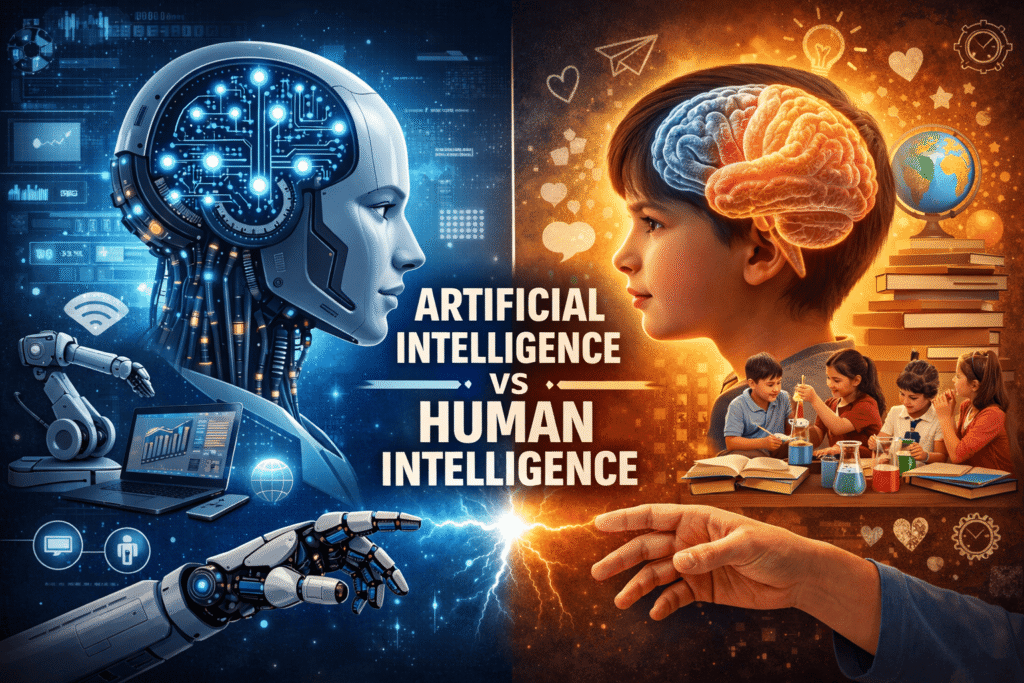
Artificial Intelligence vs Human Intelligence – A Complete Comparison
Artificial Intelligence (AI) and human intelligence are often compared because both are capable of learning, reasoning, and solving problems. However, there are fundamental differences between the two. While humans are biological beings with emotions and creativity, AI systems are machine-based programs designed to simulate intelligent behavior.
In today’s world, AI is rapidly evolving and performing tasks that once required human intelligence. This raises an important question: Can AI replace humans, or will it always remain a supportive tool?
What is Human Intelligence?
Human intelligence refers to the natural cognitive abilities of humans, including thinking, understanding, learning from experience, reasoning, emotional awareness, and decision-making. Humans can adapt to new situations, think creatively, and understand complex emotions.
What is Artificial Intelligence?
Artificial Intelligence is the simulation of human intelligence in machines. AI systems are designed to perform tasks such as data analysis, pattern recognition, language processing, and decision-making based on algorithms and data.
Key Differences Between AI and Human Intelligence
1. Learning Ability
Humans learn from experience, emotions, and surroundings. AI learns from data and training models but lacks emotional understanding.
2. Speed and Accuracy
AI can process large amounts of data much faster than humans and often with higher accuracy in repetitive tasks. However, humans excel in tasks requiring judgment and intuition.
3. Creativity
Humans are highly creative and can imagine new ideas, art, and innovations. AI can generate content based on existing data but does not truly “create” in a human sense.
4. Emotions
Humans have emotions such as love, empathy, fear, and joy, which influence decision-making. AI does not have emotions; it only simulates responses based on programming.
5. Decision Making
Human decisions are influenced by experience, emotions, and ethics. AI makes decisions based purely on data and algorithms.
Advantages of Artificial Intelligence
- Fast data processing and analysis
- High accuracy in repetitive tasks
- 24/7 availability without fatigue
- Automation of complex processes
Advantages of Human Intelligence
- Emotional understanding and empathy
- Creative thinking and imagination
- Ethical and moral decision-making
- Adaptability in unknown situations
Limitations of AI
- Lack of emotions and consciousness
- Depends heavily on data quality
- Cannot think beyond programmed limits
- Ethical and security concerns
Limitations of Human Intelligence
- Slower data processing compared to machines
- Prone to fatigue and errors
- Limited memory capacity
- Bias in decision-making
AI vs Human – Who Wins?
There is no clear winner in the competition between AI and human intelligence. Instead of replacing humans, AI is designed to enhance human capabilities. In many fields, AI works as a powerful tool that supports humans in making better decisions and improving productivity.
For example, in healthcare, AI assists doctors in diagnosing diseases, but final decisions are still made by humans. Similarly, in creative fields, AI can generate ideas, but human creativity remains essential.
Future of AI and Humans Together
The future is not about AI replacing humans but about collaboration between humans and machines. This combination, often called “augmented intelligence,” will allow humans to achieve more than ever before.
Conclusion
Artificial Intelligence and human intelligence are different but complementary. AI brings speed, efficiency, and automation, while humans bring creativity, emotions, and ethical judgment. Together, they will shape the future of technology and society.